Forensic Case Files: The Murder of Tzar Nicolas II and his Family

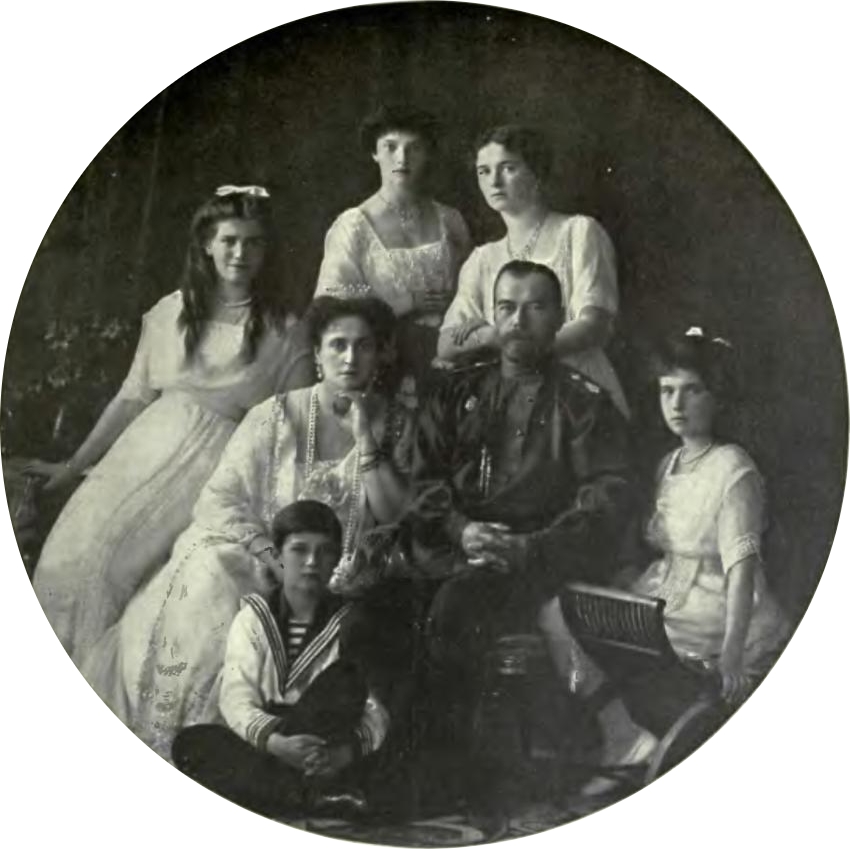
Nicolas Alexandrovich Romanov, better known as Nicolas II, the last Emperor of Russia, was murdered with his family on the night of July 17, 1918.

Tsar Nicolas had abdicated following the February Revolution of 1917, marking the end of Imperial Russia and the three-hundred year Romanov Dynasty. Following his abdication, Nicolas and his family were placed under house arrest in three locations over the following year to protect them from those involved in the Russian Revolution. Their final destination was the house of a military engineer in Yekaterinburg. At 2 a.m. on July 17, 1918, the family was awakened and was told to dress and go to the basement. They were led to believe that this was for their own protection as anti-Bolshevik forces were approaching Yekaterinburg. Instead, Nicolas, Alexandra and their children Olga, Tatiana, Maria, Anastasia and Alexi as well as four members of their household staff were gunned down by an assembled firing squad.

Nicolas was the first to die and was shot multiple times in the chest. The women of the family, clothed in gowns stitched with precious gems that afforded some protection from the first round of bullets, were finally bayoneted and shot in the head.

The bodies were taken to a nearby mine, where all their clothes and previous jewels were removed, and then the mine entrance was sealed with grenades. But the secret location of the Tsar’s resting place was leaked by several of the executioners, so the bodies were uncovered shortly thereafter and transferred to an alternate location. The Russians attempted to burn two of the bodies, but when this proved time consuming and difficult, they simply buried the remaining victims after dousing them with sulfuric acid to hide their identities. The bodies lay undiscovered for over sixty years.

In 1989, the news broke that the suspected remains of the Tsar and his family had been discovered ten years earlier, but those who knew the location had not come forward. Dr. William Maples, a forensic anthropologist from the University of Florida, offered to put together a team to examine the remains. Once in Russia, Dr. Maples was quickly able to identify the remains ― The Tsar by the shape of his face and a deformed pelvis from so many hours spent on horseback; the maid from her worn joints due to countless hours of manual labour; the Tsarina by her expensive platinum dental work; three of the four daughters by their bayonet wounds as well as pelvis maturation. Later, in 1993, with the advent of new DNA techniques, Maples’ initial results were confirmed. On July 17, 1998, the remains of the Tsar and his family were interred at St. Peter and Paul Cathedral in St. Petersburg, exactly 80 years after their execution.

But two bodies were missing, those of Tsarevich Alexei and Maria. In 2007 a small burned area was discovered in the Ural Mountains, overgrown with nettles and holding the remains of a teenaged boy and a young woman. DNA testing confirmed that the missing children had been found and the mystery of the Romanovs was finally solved.

Photo credit: Wikimedia Commons

Forensics 101: Carbon Dating

In a Forensic Case File a few weeks ago, we talked about how a French scientist concluded in 2007 that the remains discovered in Paris in 1867 were not those of Joan of Arc. One of the tools he used to determine that the remains were actually those of a 1400-year-old mummy was C-14 analysis, more commonly known as ‘carbon dating’. But what is carbon dating, and how can we use it to measure the age of historic samples?

Carbon is one of the six major building blocks of life, along with nitrogen, oxygen, hydrogen, phosphorus and sulfur. But all carbon is not created equal. Nearly 99% of elemental carbon is carbon-12 (C-12), which means that the carbon atom contains 6 protons and 6 neutrons. But there are several alternate forms of carbon; it is C-14 (a carbon atom containing 6 protons and 8 neutrons) that is crucial in carbon dating.

The most available source of carbon for living things is through the atmosphere. Plants respire, taking in CO2 and using that carbon to grow. When we eat plants (or eat other animals that eat plants), those building blocks are transferred to us. As long as we continue to eat, fresh carbon gets built into our bodies. But the moment we die, we stop taking in new carbon and that’s when the C-14 clock starts ticking as it slowly starts to break down.

C-12 is stable form of carbon, but C-14 is unstable and ultimately breaks down into nitrogen and hydrogen. Using C-14's known half-life of 5,730 years, scientists can calculate when the organism being tested died. To do this, a small amount of organic sample (bone, wood, shell, peat etc.) is pulverized and burned, producing CO2 containing a mix of both C-12 and C-14. When the sample C-12/C-14 ratio is compared to the current atmospheric C-12/C-14 ratio, scientists can estimate the age of the sample. In the case of Dr. Philippe Charlier, he was able to determine that his remains were too old to possibly be those of Joan of Arc.

Carbon dating is a valuable tool for discriminating  archeological samples from potential forensic discoveries. It has been used to date remains discovered at construction sites, confirming that a modern forensic investigation is not required, and allowing the remains to be returned for proper reburial to the Native American tribes originally populating the area of discovery.

Photo credit: tantek

Writing For The Love Of It

When we first start to write, we write for the sheer joy of it, for the love of storytelling and being creative. To a certain extent, that changes when we start to write professionally. Then we no longer write just for ourselves. Now there are genre and grammar rules that must be followed and other people to satisfy ― our agents and editors, our readers. Also, as much as we love to write, at that point it begins to compete with the business aspect of an author’s career. And with that come the distractions of what is now expected of an author ― social networking on multiple platforms and marketing. For many of us, it can become a crushing pressure to do all of this on top of maintaining a 40-hour workweek to put food on our tables.

Ann and I are currently working on a new proposal. As with any new project, the front end tends to be heavily loaded with technical aspects and the research that is required for proper planning ― locations, character creation, details of involved agencies, new scientific details etc. It’s easy during this period to forget why we loved to write because, well, we aren’t writing yet.

Last week I was really feeling it. There’s a lot going on in my life right now between work, family and writing, and I knew I needed to find an outlet. I sent out the request, and Ann was immediately on board. When we started writing together years ago, it was just for us, so we took a short break to go back to where we started. It’s been a long time since we were able to do this and I have to say it really felt great. It was different than before ― learned craft is now involuntary, and bad habits like passive voice and head hopping are now mostly non-existent (or are caught and edited out) ― but there is something freeing in just writing for the sheer joy of it. And if no one saw it but us, it would still be worthwhile.

How often do you take some time to just write for you? Or, for other creatives, to just sing or paint or draw, just for you? Does it refresh you to go back to your professional craft, remembering why you love it so much?

Photo credit: hpaich

The Art of the Shocking Plot Twist

*Warning* ― Contains spoilers for books and movies included in the discussion.

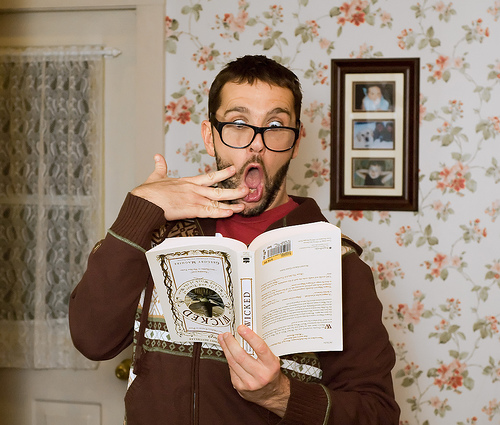
An unforgettable plot twist can leave a reader slack jawed and blinking in disbelief at the page. It can make the story more compelling and, depending on the timing, can up the stakes and intensity, or take the story in a completely different direction. But this isn’t a device for books alone; it can happen in any form of storytelling. M. Night Shyamalan stunned viewers when his final act of The Sixth Sense revealed that Bruce Willis’ protagonist had been killed in the opening scene and that the only real interactions in the movie took place with the small boy who stated that ‘he could see dead people’. Willis was a ghost.

When I was a teenager, years before the Young Adult category of books even existed, I moved from reading children’s books to reading many of the classic mystery novels around the house ― Arthur Conan Doyle, Earl Stanley Gardner, Agatha Christie and the like ― and there were two distinct times in my memory when Dame Christie left me gaping at the written page with her plot twists.

  • The Murder of Roger Ackroyd ― A Hercule Poirot novel, told from the first person perspective of Dr. John Sheppard, Poirot’s assistant during this case. Following the suicide death of a wealthy widow who admitted to killing her husband, the man expected to marry her is found murdered. The numerous suspects include the victim’s family members, the household staff and the victim’s neighbours, but, in the end, Poirot accuses Dr. Sheppard, the narrator, of committing the crime. This was my first experience with an ‘unreliable narrator’ and it left me stunned. It was an interesting literary device ― using omission and evasion on the part of the narrator to hide the fact that he was, in fact, the murderer.
  • And Then There Were None (also published as Ten Little Indians in the U.S.) ― A group of strangers are invited to an isolated island off the coast of Devon, England. During their first dinner together a gramophone is played, accusing each of them of the crime of murder. Over the course of the next several days, the guests are killed off one by one, each in accordance with a verse in the poem ― The Ten Little Indians ― found framed in each guest’s bedroom. Nine guests die and then the final guest, exhausted and overwhelmed with guilt, finds a noose hanging in her room and kills herself. Later it is revealed that Judge Wargrave, the sixth victim, staged his death with the help of one of the other guests, who he then killed as the seventh victim. Once everyone on the island was dead, Wargrave ingeniously took his own life to resemble his original ‘death’, leaving the police with a truly mindboggling puzzle. The judge’s confession and explanation is later found as a message in a bottle, revealing the details of his nefarious plan. The conclusion to this story caught me totally off guard. Essentially, it is sleight of hand ― once Wargrave is declared dead, the reader discounts him as a suspect, and, at least for me, the possibility that any of the deaths might be questionable never occurred to me.

These are only two examples, and certainly not an exhaustive list. As a reader, what are the most memorable twists that you can remember?

Photo by CarbonNYC

Forensic Case Files: The Lost Remains of Joan of Arc

Forensic science can be used for so much more than victim identification or determining cause of death in criminal cases. One such alternate use is shedding light in historical venues. An example of this was the modern day examination of the putative remains of Joan of Arc, originally discovered in 1867. Were they real? Forensic science was able to reveal the truth.

Joan of Arc (1412 – 1431) was a French peasant girl who claimed that she had visions of several saints telling her to drive the invading English from her country. Four years later, she appealed to the Dauphin to allow her to lead the army into battle, saying that God himself had instructed that she do so. As the French were at a very low point in the war, the Dauphin gave his permission.

Joan’s accomplishments during battle are still under discussion, but it is believed that she was a successful strategist and tactician, allowing the French to win many crucial battles and helping to turn the tide of the Hundred Years’ War. What is generally agreed upon, however, is that Joan used her position to turn the conflict into a religious war.

Joan was captured by the English in May of 1430, and was tried for heresy and witchcraft based on her statements that God had commanded her to lead her army into battle. She was found guilty and was burned at the stake on May 30, 1431 at 19 years of age. After death, her body was burned twice more until it was reduced to ashes. Then her remains were cast into the Seine to prevent their recovery by the French.

In 1867, a dusty glass jar was discovered in the attic of a Paris pharmacy. Labelled ‘Remains found under the stake of Joan of Arc, virgin of Orleans’, the jar contained what appeared to be a charred human rib, a chunk of burned wood, a swatch of linen and the thigh bone of a cat (it was common practice in the 14th century to throw a black cat on the pyre of an accused witch to burn with her). The Roman Catholic Church believed these artifacts to be real and included them in a museum that was part of the Archdiocese of Tours.

Dr Philippe Charlier, a Parisian forensic scientist, wanted to subject the remains to modern science to prove their validity. After receiving approval from the Church, he conducted a series of tests. The black residue that covered the rib bone was discovered through mass spectroscopy to be a vegetal and mineral matrix consistent with embalming materials used by the Egyptians centuries before the Common Era. Carbon-14 analysis of the relics dated them between the third and sixth centuries B.C.E. Odour analysis of the remains detected a vanilla-like scent. As vanillan is produced by decomposing remains, this only strengthened the argument that the remains had not been cremated. In the end, Dr. Charlier concluded that the remains were from an Egyptian mummy, dead for centuries before Joan lived. His results were published in the journal Nature in April 2007.

The Church accepted these results as fact, declaring that it is now likely that Joan’s remains are lost forever.

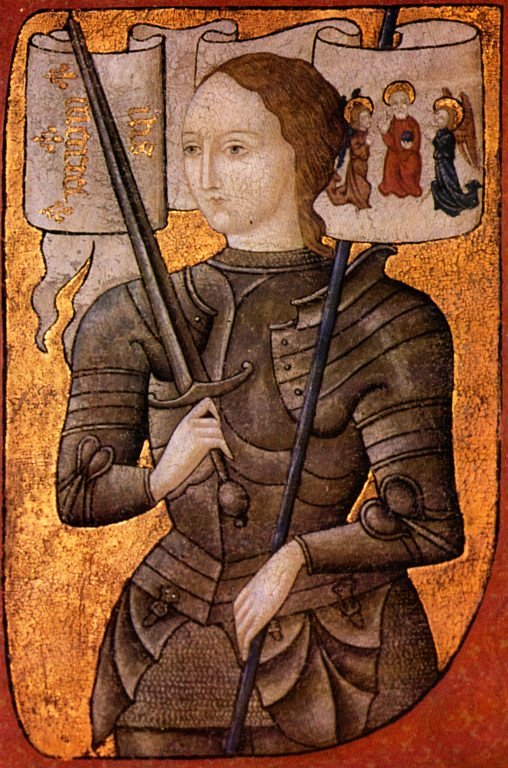
Painting of Joan of Arc, artist unknown, circa 1485.

Playing Hooky Is Good For The Soul

Ann and I were supposed to be working most of this weekend on a new project. After a week of research, this was when we’d agreed to start putting our respective heads together to get the planning off the ground. But when it’s Thanksgiving weekend in Canada, it’s 26oC/79oF without a single cloud in the sky, and you know that within six weeks the snow will be flying... well, let’s just say it’s not hard to talk yourself into heading outside instead of sitting inside staring at your monitor.

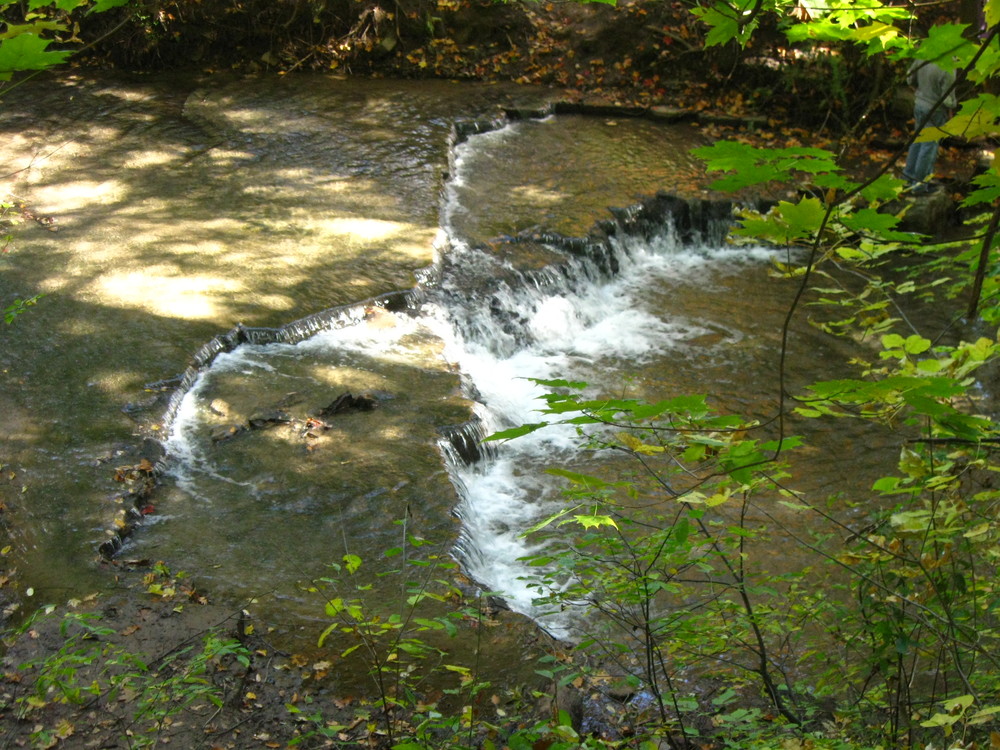
On Sunday, after a really productive morning of joint planning, I played hooky and went out with the family for a hike in a nearby conservation area. So, instead of my regular blog post on writing or forensics, today I bring you instead the beauty that is fall in Southern Ontario (because apparently I’m playing hooky on the blog too). Special thanks to my oldest daughter for her photography skills as well as her mad Photoshopping skills because all nature looks nicer with no people in it!

It was a beautiful, peaceful and fun few hours away from work. And I came back recharged and ready to hit the keyboard again. I don’t do it very often, but occasionally playing hooky is good because sometimes we all just need a break and a breath of fresh air.

  Spencer Gorge

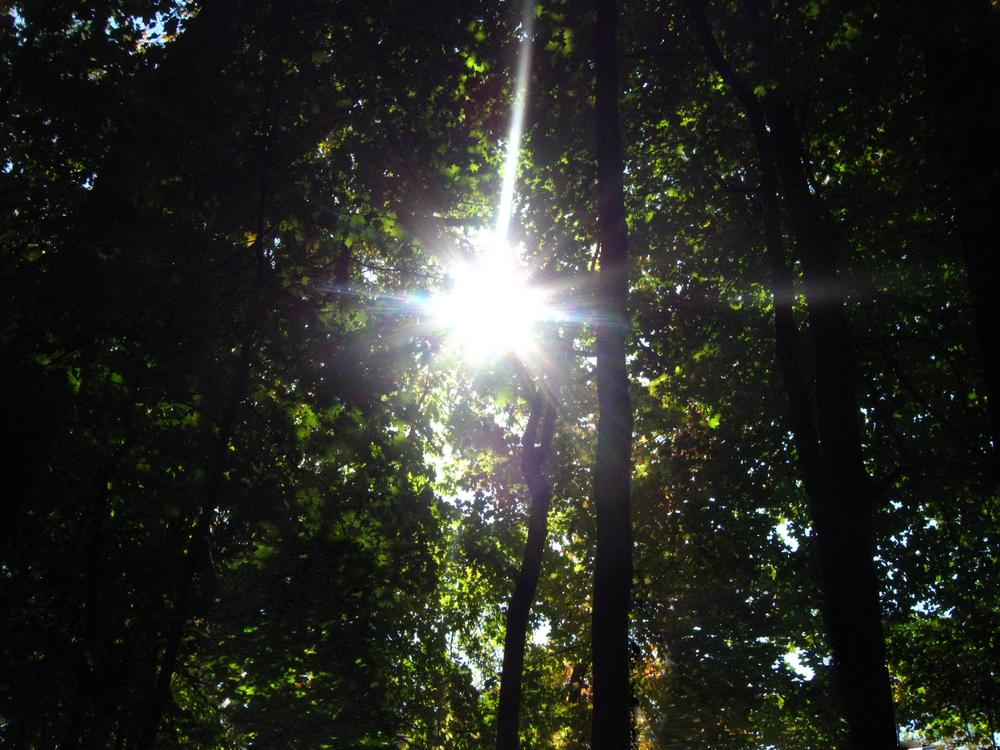
Sunlight breaking through the trees

Logies Creek at the top of Tewes falls

  Tewes Falls

  Looking towards Dundas Peak

  The view from Dundas Peak

So who else played hooky this weekend? It was a beautiful weekend in the northeastern States and Ontario. I know I wasn't the only one. Come on, 'fess up!

Photo credit: Jess Newton

Writing Workspaces ― The Usual and the Unique

As writers, most of us have an established workspace. A space we've claimed as our own, where we can be comfortable enough to spend hours getting lost in that creative mindset we love so much. But where we write can be as individual as what we write.

When we moved into our house fifteen years ago, my husband claimed the den as his workspace (he's a computer guy and always has programming etc. on the go). As I hadn't returned to the world of writing at that point, it made sense. But later, I needed a place to call my own and we didn't have a room to repurpose with two kids and a full house. But, in the end, our spacious oak dining room table perfectly suited my needs. Located on the main floor, it's in a shared space with the kitchen and living room, allowing me to write and simultaneously cook/assist with homework/generally oversee family life. It's right in the middle of our family chaos and that makes it perfect for me. If I need privacy to work, I put on my headphones, crank up an appropriate soundtrack and off I go into my own little world. And I have the added bonus of my daughters often sharing the space with me as they crash on a living room couch with their own laptop, so writing is rarely a solitary act for me.

But what about odd spaces? We've all had moments when we've had to carve out writing time when we aren't in our usual spots. For me those spaces have been many and varied:

  • Having an idea hit hard while traveling on a family vacation and spending hours sitting in the passenger seat while my husband drove, typing madly to get the scene down before it disappeared.
  • Needing time out of the lab and finding it under a tree in the middle of the campus quad, surrounded by students lying in the grass reading or playing Ultimate Frisbee.
  • In elementary school hallways between volleyball tournament games when my youngest daughter was off-court.
  • Sitting by my mother's bedside in the ER after she broke her hip. This definitely wins the prize as the oddest spot for me. How I managed to write one of our most emotional and intimate scenes to date in the middle of that chaos and emotional turmoil is beyond me. Perhaps turning that turmoil around and pouring it into my characters really helped give it that extra emotional boost.

What about you? What space do you use for your creative pursuits and have you ever been forced to make use of the space that is handy versus the space that you've made? How successful were you in those odd spots?

Photo credit: JimboRocks

Forensics 101: Sexing an Unidentified Victim Based on Skeletal Markers – The Skull

Ideally, when human remains are found, the whole body is recovered. If so, multiple skeletal components are used when determining the sex of the victim. Unfortunately, it is common that only partial remains are discovered. In the last Forensics 101 post, I discussed how to sex a skeleton based solely on the pelvis, which is considered the most reliable method of sexing adult remains. But what if only the skull is recovered? Luckily, a forensic anthropologist has a few tricks of up his sleeve and can tell quite a bit from a human skull.

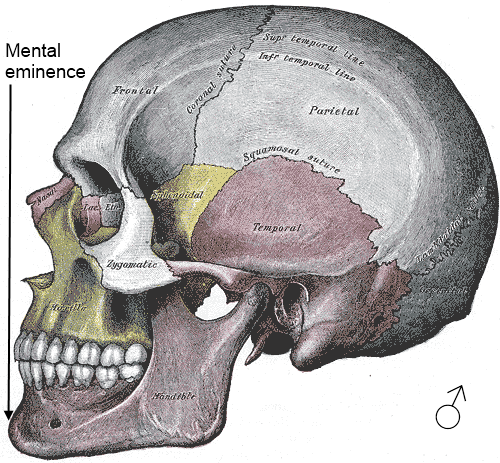
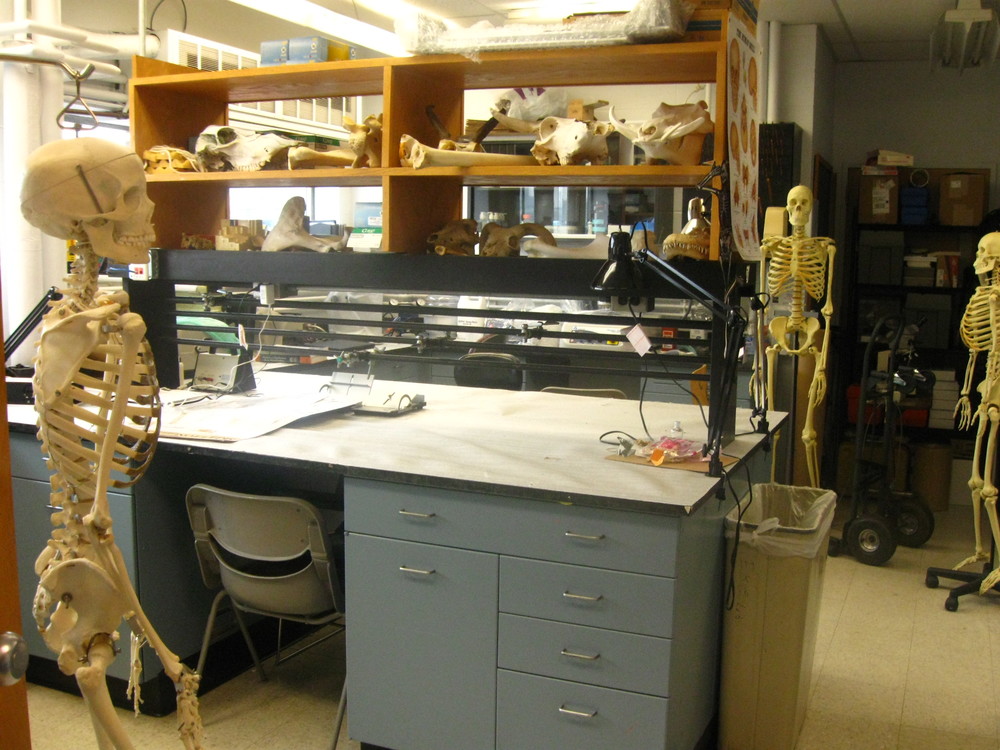
I have included several photos to illustrate the relevant skeletal markers used in sexing a skull. Since all the available skeletal specimens were female, I’m using an illustration from Gray’s Anatomy to include details of the male skull.

  • Mastoid process ― This is the point of attachment for the muscles in the neck and torso that allow you to turn your head. As male musculature tends to be more robust than female musculature, the male mastoid process tends to be larger in size.
  • Supraorbital ridge/glabella ― This area is located between the eyebrows, just above the nasal aperture. In females, the glabella tends to be flat, with no prominence. In males, there can be a slight to a heavy prominence.
  • Mental eminence ― In layman’s terms, this is the chin. In females, this area tends to be flat, or with only a small projection. In males, the projection can be mid-range to quite large.
  • Nuchal crest ― This is the attachment point for the nuchal ligament and nuchal musculature, connecting the head to the spine and assisting in its support. Less pronounced in females, it can form a significant projection in males, sometimes even taking the form of a bony hook.

Besides contributing to sex determination, the skull is also very useful in determining race as well as the age of the victim at the time of death. In the next Forensics 101 post, we’ll look at how to determine age of a victim based on skeletal remains.

Thanks to the McMaster University Department of Anatomy for providing skeletal specimens.

Cutting the Fluff in Your Writing

In an increasingly competitive publishing market serving today’s society of readers afflicted with short attention spans, it’s more crucial than ever to write tight prose. But as weavers of words, authors want to be able to paint descriptive scenes and write emotive characterization, not simply shotgun plot points. So how do we find that elusive middle ground?

American writer Elmore Leonard once said “I leave out the parts that people skip”. But the question is ― what are those parts? What qualifies as fluff? And how can we cut the fluff and still leave a well-rounded story?

Fluff in writing could be described as anything that doesn’t move the story forward, set the mood or expand on your characters. With that in mind, here are some suggestions on how to cut the fluff from your own writing:

  • Avoid info dumps, especially early in the story. Chapter One is not the place to detail your character’s entire past life. This mistake is often made by beginner writers because they don’t yet know their own characters well enough.
  • Readers very rarely skim dialogue. So use dialogue whenever possible to advance the story and inform the reader. Be careful to keep the discussion tight and avoid padding it with throwaway conversation.
  • Integrate details of character/conflict/action with description to avoid large chunks of undiluted description. This has the added bonus of allowing the reader to see the setting/plot through the character’s eyes as described a few weeks ago in How to Create Mood and Atmosphere in Fiction.
  • Make the setting a ‘character’ in your story so that all included description is crucial to progressing your plot. Build in key elements of the setting to enhance the reader’s understanding of time and place.
  • Make sure that you only include details that are paramount to the story, not because they are important to you as the author. This information can be retained if you make those aspects important to the character and, therefore, relevant to your story.

Of all the points listed above, the last one is certainly the one that is nearest and dearest to my heart. I tend get too attached to specific places or certain aspects of science and I need to be reined in. Luckily for me, I have a partner and an agent who aren’t afraid to share their honest opinions with me.

How about you? Do you have bad habits when it comes to writing fluff that you have to weed out in the editing stage? Or do you have your own strategies on how to streamline your prose?

Photo credit: jspad

Real Life Interrogation Techniques For Crime Writers

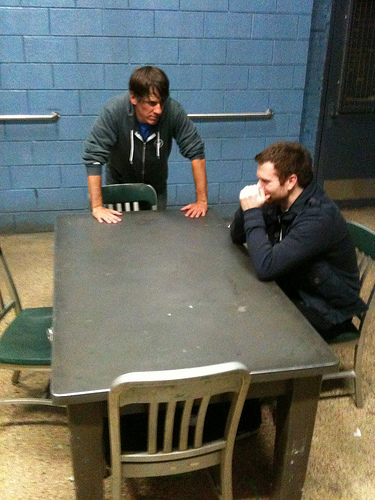
We’ve all seen them on TV: interrogations where the armed cop stands over a cowering suspect, screaming ― complete with colourful language ― for the perp to come clean or else. The perp is occasionally even tossed up against a wall or roughed up in some way. But is this really how the police handle a real life interrogation?  

Absolutely not.

Recently at Killer Nashville, I attended a session on realistic interrogation techniques. For those of us are trying to write law enforcement accurately, it was interesting information and really showed how inaccurate TV portrayals of officers can be (the instructor kept referring to “TV crap”). 

The following tips come care of Special Agent Mike Breedlove of the Tennessee Bureau of Investigation:

  • Never enter an interrogation room armed. This rule you see broken on TV on a regular basis, but the truth of the matter is that most officers are shot to death with their own gun. So the interrogating officer should never wear a weapon when entering a small enclosed space with a suspect.
  • The number one success factor is privacy. Get your suspect alone. Psychologically, that has an immense impact on how he or she will react. Observers can view through mirrored glass, but the suspect should be alone in the room with the officer(s). Some officers prefer to make it an almost intimate setting with no table between them, simply two chairs. This allows the officer to physically reach out to the subject if he senses that they are weakening or reaching a breaking point.
  • Keep the interview non-confrontational (sorry, Jack Bauer, you never got this one right). Interview is actually the key word here, and you want to keep the discussion conversational. The moment the officer becomes confrontational, most subjects will get defensive and will simply stop talking. Choose your words carefully. Don’t use terms like ‘kill’ or ‘steal’. Instead, try to downplay the incident in the hopes that the suspect will be more likely to talk about it. Use casual or slang terms; don’t try to intimidate your suspect with language. And absolutely no swearing while in the interview room.
  • You’re not looking for a confession; you’re looking for the truth. Those could be two different things. Some suspects might confess to a lesser crime in order to hide a greater misdemeanour.
  • Attitude is everything and confidence is key. If the subject senses fear from the investigator, it’s game over from that moment on. Also, know the facts of the case going in. If you go on a fishing expedition, most suspects will know immediately that you don’t have enough information to hold them. Treat the suspect with respect no matter how heinous their crime.
  • Pay attention to every word because lies are as important as the truth.
  • Every suspect has rights. In North America, the moment an attorney is requested, the interview must stop immediately.

Hopefully this will be a useful list for those of you writing mysteries and crime fiction. I know it certainly made me look at some of my own scenes with fresh eyes. 

Photo credit: dpstyles 

How to Create Mood and Atmosphere in Fiction

As writers, we want to invite readers into the worlds we create as seen through the eyes of our characters. If done well, this not only immerses the reader completely in the story itself, but, in turn, makes our characters more three-dimensional. But how can we create the kind of atmosphere that draws readers in, while still keeping them emotionally involved in the story itself and not overloading them on details?

  • Use all five senses when describing a scene: Many writers depend only on sight to describe a scene, but don’t forget the other four senses. There’s a whole world out there based on scent, texture, sound and taste. People who are visually challenged can give wonderful descriptions all without the sense of sight because they depend on their other senses for information.
  • Don’t write a checklist: Some writers will include multiple sensory descriptors, but it’s done in checklist form (Visual cue? Check! Auditory cue? Check! Tactile cue?...). As a result, these descriptions totally lose their emotional punch.
  • Use atmosphere to add a little backstory: When a character notices a particular detail, it can recall a memory for them that introduces a tiny bit of backstory to help build that characterization. Someone who grew up on a farm would be more likely to notice the smell of freshly cut hay or recognize the sound of a mechanical harvester, so pad the description with a bit a memory that makes it real for that character.
  • Don’t describe everything to the nth degree: Leave a little of the scene to the reader’s imagination so they can make it their own. This makes it a personal experience for the reader.
  • Don’t overload the front end: Pay attention for ways to pepper description through the action in a story. Don’t spend the first five pages in description simply because you spent a month solid worldbuilding. Find ways to weave that description through the novel in judicious amounts.
  • Use the mood of the narrator to translate the scene: The same character will view the same location in two drastically different moods in different ways. Use these details to highlight the character’s emotional state.
  • As always, any rule in writing can be broken if you do it well. Writers are told to never open a novel with the weather, but I guarantee, if you do it well, your readers will be so engrossed that they won’t notice that you broke the rule in the first place.

What about you? Are there any tricks that you have to create mood and atmosphere in your own writing?

Photo credit: hpaich

Dr. William Bass, Creator of The Body Farm

It was a pleasure this past weekend to meet a living legend in the field of forensic anthropology ― Dr. William Bass. Dr. Bass is half of the writing partnership of Jefferson Bass (with Jon Jefferson), but in the world of science, his claim to fame is as the creator of the University of Tennessee’s Forensic Anthropological Research Facility, better known as 'The Body Farm'.

Even though he has supposedly been ‘retired’ for 16 years, Dr. Bass is still an active part of the University of Tennessee (UT) and the research center he created. He’s very proud of his time at UT and stated that, as of that day, he’d been there 40 years, 1 month and 6 days. He started 'The Body Farm' in 1980 to increase scientific understanding of what happens to the human body following death with the direct intent of assisting in crime scene investigation. Over the years, he and his students have studied as many variables as possible ― outdoor surface vs. burial decomposition, indoor decomposition, insect infestation/maturation as an indicator of time since death, carnivore scavenging, chemical substances produced during decomposition, the effect of trauma on decomposition, race determination through computer analysis and much more. What started as a little known facility with only a few donations per year is now a major center for scientific investigation with more than 100 cadaver donations annually. After decomposition, all remains are finally stored at UT in what is now the world’s largest skeletal collection, the William M. Bass Skeletal Collection.

Dr. Bass was the speaker for the opening session of Killer Nashville with a talk entitled ‘Bones Do Talk’. A very spry 83 (today is, in fact, his 83rd birthday), he was an immensely entertaining speaker, sharing his own personal stories from a varied and colourful career in academia and while assisting law enforcement. To illustrate his teachings, he brought along a box of ‘friends’ ― skeletal specimens from past cases. It was an interactive lecture, with members of the audience assisting with his case-by-case analyses. He led us through blunt force trauma slayings as well as piecing together a death scene and cause of death from a skull with three apparent bullet defects (the fourth defect was hidden as the bullet exited through the eye socket).

He also included interesting facts on bone growth from infancy to adulthood, comparing a newborn femur to an adult femur to illustrate the process of growth ending in epiphyseal fusion to seal with growing ends of the bone to the shaft.

From a personal standpoint, Dr. Bass has been my scientific companion through my writing career. I have binders full of his papers (and those of his students) that have been instrumental in allowing me to create crime fiction grounded in scientific truth. So, it was the highlight of the conference for me to sit through one of his lectures and a personal thrill to make his acquaintance. He’s a very friendly and gracious Southern gentleman who shows no sign of slowing down, no matter what his age. Clearly, he loves what he does and knows what a difference it makes, and will continue to do what he can to expand upon our knowledge and to bring the missing home.

Knowing When It's Time To Take A Break

As writers, we work hard to keep all the balls in the air. Research, writing drafts, revising manuscripts, producing proposals for future projects, blogging and maintaining multiple social media platforms, as well as our own websites. Those of us that don’t have the luxury of writing full time have a 40-hour workweek to manage as well. Add to that the fact that many of us have spouses and families, and life for a writer can be... well... crazy at the best of times.

Last week I hit a wall. My trip to Massachusetts had been planned for months when my agent requested some extra work be done on a particular project a week before we left. Knowing that I was going to lose a week to my working vacation added extra stress, but I got right to work as requested. But the load really hit once I got back from vacation. The daily grind of working all day in the lab and then putting in another six hours or so on the project when I got home as well as 18-hour days on week-ends took its toll after about a week and a half. I really knew I was pushing it when I started getting dizzy spells at work (which is never good from a safety standpoint, especially when you work with HIV). But when a project has to be completed, you power through until it’s done. And you go through a lot of coffee in the process.

Last Thursday night, I sent that project to Nicole. On Friday, I was an absolute mess. Even my lab mates were teasing me good-naturedly that I was there in body but not in mind, and that I was being uncharacteristically klutzy. I think my brain and body had jointly decided that now that the pressure was off, they were taking a vacation whether I wanted it or not. So, I treated myself to two whole days of doing almost nothing ― relaxing in front of the TV with my husband, taking my girls swimming, hanging out for an afternoon with my mother (who’d almost forgotten what I looked like by that time) and generally giving my brain permission to recharge. After that brief break, I felt like myself again and now I’m back on track prepping for my editor pitches at Killer Nashville this week.

There definitely comes a time when we can’t keep pushing ourselves because what we produce won’t be worth the effort. Sometimes we need to give ourselves permission to recharge and then come back to the game rested and ready to do the job right.

How do you manage to keep all the balls in the air when the combined pressures of life and your job(s) threaten to take everything out of you?

Photo credit: hpaich

Creative License ― How Much Is Too Much?

The writing that Ann and I do together is known for its realistic edge ― from the forensic science to professional roles to locations, it’s all highly researched and portrayed as it exists in real life. So it was a shock to find out during my recent trip to Boston that the professional duties of one of the characters we portrayed in our series was, in reality, quite different from what we had written. More than that, this new information impacted the core case of the novel from a forensic standpoint. This left Ann and I with quite a dilemma ― do we rewrite our manuscript around this new information, or do we use creative license to ignore it?

The Mirriam-Webster dictionary defines creative license as a “deviation from fact, form, or rule by an artist or writer for the sake of the effect gained”. Those writers who write fantasy have the advantage of never needing to use creative license because they can alter reality as it suits them during the worldbuilding stage of their process. But for those of us who try to portray reality as accurately as possible, creative license is almost a four-letter word. Because of our intention to write about local forensic and law enforcement processes as they actually occur, this was a huge stumbling block for us.

What we had written was actually correct… for any other state except Massachusetts, it seems. We had done our research and knew the facts, but this was a matter of local budgets butting up against the scientific process. In this case, the budgets won. From the standpoint of someone standing on the outside looking in, I can only wonder how many convictions are lost because budgetary restrictions allow reasonable doubt to form in the mind of the jurors. I’m betting it’s quite a few.

In the end, it was my agent Nicole who suggested the best work-around for this issue, one that used only a minimum of creative license. Her solution not only brought to light the reality of the situation but also put a twist on it, so we can still use what we had already written. It also allows us the latitude to continue as we had planned concerning this character in our continuing series. Let's hear it for teamwork!

How do you use creative license in your writing? Do you consider it a godsend or a necessary evil only to be used when you have no other choice? I’d love to hear your thoughts on it…

Photo credit: Bright Meadow

The Salem Witch Trials Memorial ― Remembering Those Lost in 1692

In 1692, led by the hysterical accusations of a handful of bored Puritan teenage girls, over one hundred and fifty innocent men and women were accused and imprisoned under the charge of witchcraft in Salem, Massachusetts. Of those, twenty-nine went to trial and all were found guilty. It was a true kangaroo court: The girls came to court to accuse their ‘tormentors’ and would often throw hysterical fits, claiming to see the spectral evidence of the devil, sent by the accused to attack them. If a verdict of not guilty was handed down, the testimony from the girls would simply continue until the jury could comfortably settle on a guilty verdict. From June to September of 1692, twenty innocents were publically executed under the pronouncement that they were witches, and at least another five perished due to the deplorable conditions of imprisonment in the witches’ dungeon.

All the victims except Giles Corey were hung at Gallows Hill; he was pressed to death. The law of the time demanded that your lands would be forfeit as soon as a plea of guilty or not guilty was entered for the charge of witchcraft. Knowing he would likely die, and in order to ensure that his lands were passed down to his family, Corey refused to enter any plea. The magistrates attempted to force a plea from him by strapping him under a wide plank or door and adding hundreds of pound of rocks to crush him into an admission. The story is told that Giles Corey remained silent for three days, slowly being crushed to death. His final words were simply ‘more weight’. After he died, his lands passed on to his children.

Was witchcraft really involved? Were these men and women tried for practicing the old Celtic traditions of the Goddess? No, the accused were all devout Christians, but the prevalent fear of the time that Satan actively walked the earth among them fueled the panic. Laurie Cabot, the official Witch of Salem puts it best when she describes the hysteria as “what can happen to a Christian community that succumbs to an irrational fear of the devil and projects this evil image onto members of the community”.

When the hysteria died down following the final deaths in September of 1692 and the close of the regional trials in 1693, calls for justice came from the community and petitions were filed to reverse the convictions of those who were convicted but not yet executed. Those who were still imprisoned were released and the community returned to normal. Years later, Ann Putnum, one of the girls involved in the hysteria, gave a public apology, stating that she had been deluded by Satan into denouncing innocent victims.

In 1992, on the three-hundredth anniversary of the trials, the City of Salem opened the Salem Witch Trials Memorial Park as a tribute the twenty victims killed in 1692. It is located adjacent to the historic Old Burying Point on Charter Street, where Jonathan Corwin and John Hawthorne, judges in the Salem Witch Trials, are buried. The park consists of a large area of open green space, surrounded on three sides by a granite wall. Six locust trees grace the center area, chosen intentionally as they are the last to flower in the spring and the first to lose their leaves in the fall, representing the stark injustice of the trials. Twenty cantilevered stone benches, one for each victim, encircle the park.

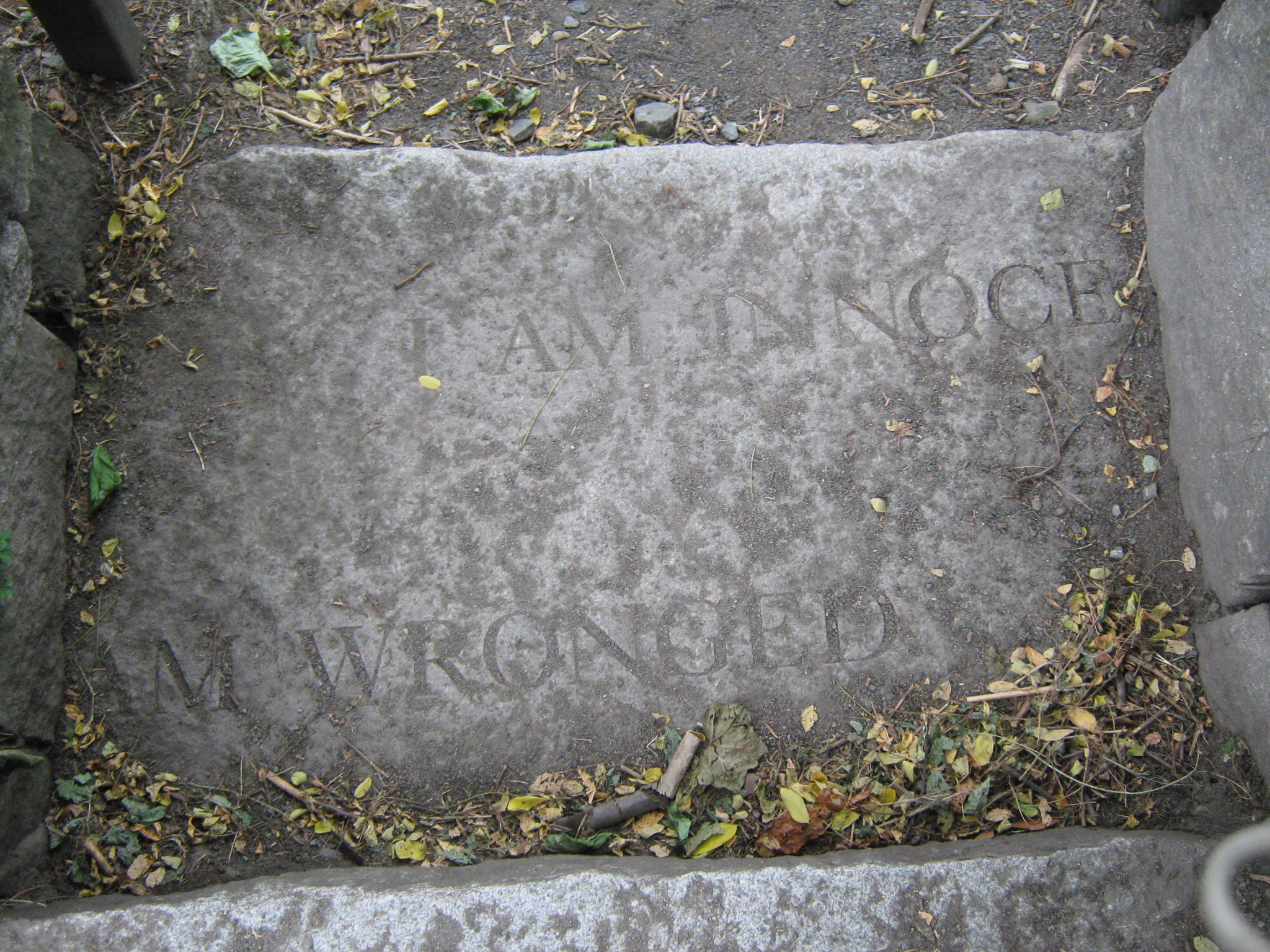
The entranceway to the memorial is carved with quotes from the victims, all emphatically stating their innocence and crying out to their God for help. Many of the quotes are abruptly cut short, just like those twenty lives.

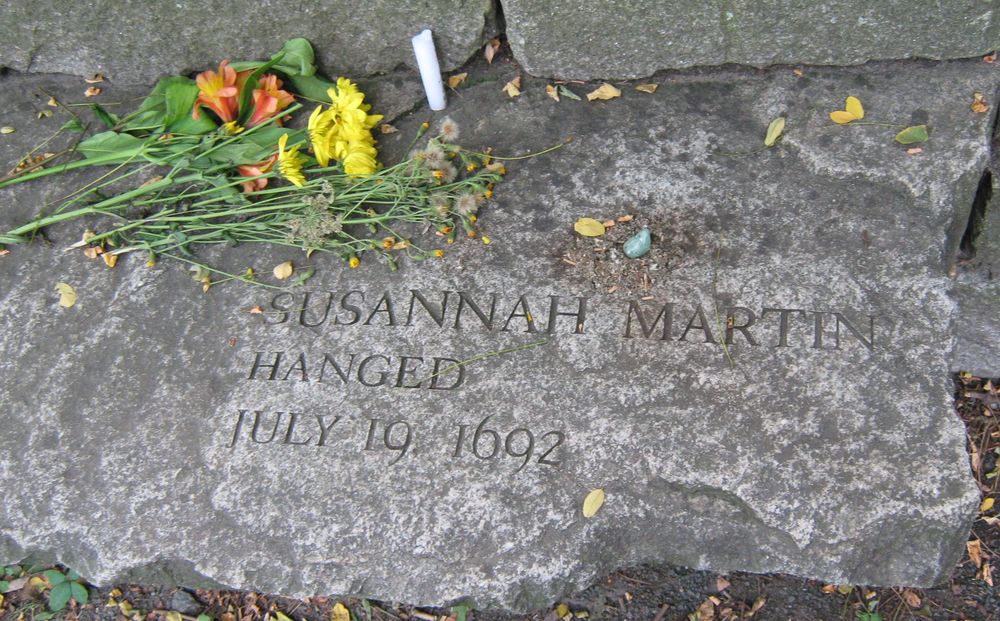
Remembrances for the victims are left by visitors and members of the community alike ― fresh and dried flowers, candles, corn husk dolls, wreaths and hand written notes. The presence of the witchcraft community is felt as well. Pictured above is a crystal surrounded by small circle of charged herbs and flowers; this is a token from the very active witchcraft community of Salem.

A fresh red carnation lay on Rebecca Nurse's bench along with a florist’s card that read ‘In loving memory, from your great... granddaughter’ and a signature. It’s amazing to think that over 300 years later, relatives of those slain during the hysteria still come to remember them.

This park is also the centerpiece of the annual Samhain (Halloween) candlelight vigil and ceremony of the witchcraft community within Salem, the park being large enough to accommodate a circle of several hundred people. Each Samhain, a time when they consider the veil between this world and the next is at its thinnest, members of the community gather to celebrate and remember those that have gone before them, surrounded by the memory of those who were wrongly accused and executed.

In remembrance:

Bridget Bishop, hanged on June 10, 1692

Sarah Good, hanged on July 19, 1692

Rebecca Nurse, hanged on July 19, 1692

Susannah Martin, hanged on July 19, 1692

Elizabeth How, hanged on July 19, 1692

Sarah Wilds, hanged on July 19, 1692

George Burroughs, hanged on August 19, 1692

John Proctor, hanged on August 19, 1692

John Willard, hanged on August 19, 1692

George Jacobs, Sr., hanged on August 19, 1692

Martha Carrier, hanged on August 19, 1692

Giles Corey, pressed to death on September 19, 1692

Martha Corey, hanged on September 22, 1692

Mary Eastey, hanged on September 22, 1692

Alice Parker, hanged on September 22, 1692

Ann Pudeater, hanged on September 22, 1692

Margaret Scott, hanged on September 22, 1692

Wilmott Reed, hanged on September 22, 1692

Samuel Wardwell, hanged on September 22, 1692

Mary Parker, hanged on September 22, 1692

A Return Trip to Salem and Boston

A few months ago, I wrote a blog post entitled The Kindness of Strangers When Researching Your Novel that I’d like to expand on. In that post, I talked about the how the contacts I made while researching my first novel (prior to actually writing it) made all the difference in how that manuscript turned out.

I learned my lesson well from that trip and planned this summer’s family vacation around a second trip to Massachusetts, this time with my daughters in tow (my poor husband got stuck at home...). It was a real pleasure to be able to show them an area that I’ve loved since I was their age, but, more than that, it was great to be able to involve them in my novel planning. Writing takes a huge amount of my time, so if they can be involved in the process, it makes it a more enjoyable experience for all of us. There’s nothing better than being boots-on-the-ground in the places I’m writing about to achieve that.

But this trip ended up being about more than just my work-in-progress. Through the kindness of my contact at Boston University, Dr. Tara Moore, I was able to get into their forensic anthropology labs to talk to the researchers and instructors there about their current research, their body farm program that is just getting off the ground, and the trials and tribulations of being involved with law enforcement.


In a marathon four-hour session, we met with the retired FBI agent who teaches their crime scene courses at Boston University, the neurobiologist who now works as a forensic anthropologist/osteologist, the Massachusetts State Police Crime Scene Services lab in Boston, and the State Police liaison with the Massachusetts Medical Examiner’s Office. The information I learned applies to the entire series and was pure gold in terms of writing their world correctly. To top it off, my youngest daughter (those are her hands, above, holding the skull) was offered a position next summer sorting bones for a week, which she would love to do. Lucky kid... what an offer for a grade nine student!

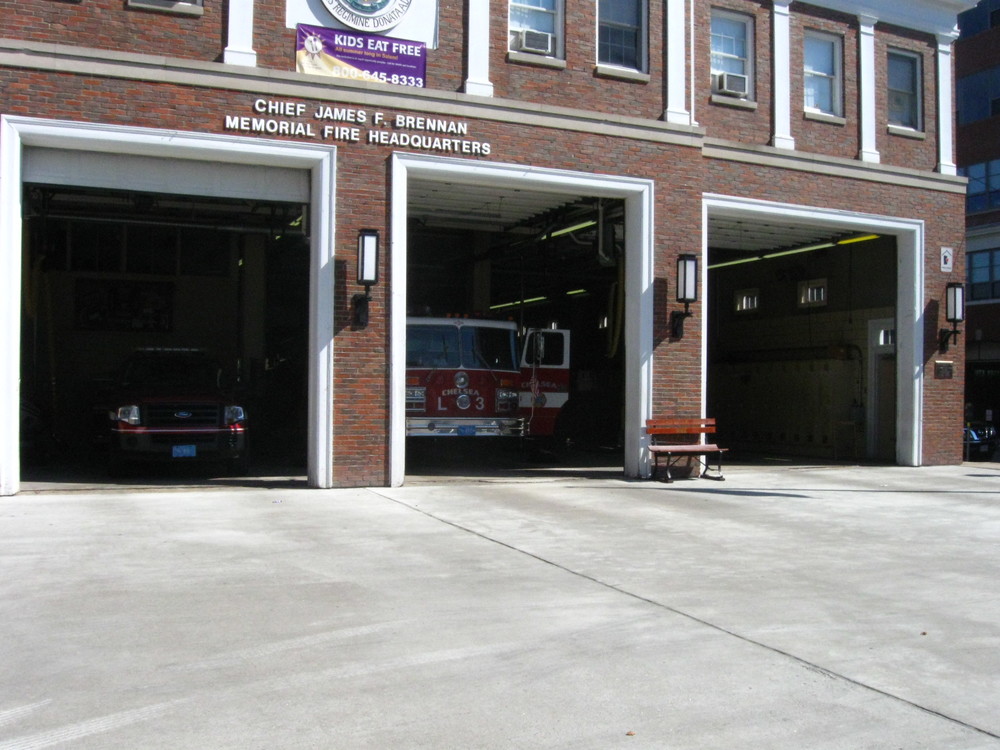
We met with the Salem Fire Department, laying the ground work for much of the fire investigation in our work-in-progress. Ann and I are already working with our California fire contact, Captain Lisa Giblin, however, we wanted to make sure that our protocols were firmly east coast vs. west coast ― getting into the fire department ensured that. We met with many members of the department; everyone was very friendly and willing to share their own personal knowledge.


We toured the sites in Salem that will be used for scenes in the book as well. As a visual writer, getting pictures of places I want to write about is absolutely crucial. Google Earth is great, but this is the kind of detail that I really need.

Our biggest adventure was when we attempted to cross the salt marsh on the Essex coast. This site plays a major role in DEAD, WITHOUT A STONE TO TELL IT, but when I visited two years ago, I didn’t actually enter the marsh as I was on my own and was worried I might get into trouble. Well, this was an eye opener. The marsh looks so pretty, but try to cross it and you can get into some major trouble very quickly. Both myself and my older daughter had to be pulled free from the very deep, sucking mud in the Essex River channels, and when we finally admitted defeat after over a half hour later, it was to emerge bloody from marsh saw grasses, covered with greenhead fly bites and literally covered up to our knees in mud. It's a beautiful and tranquil area... and is incredibly treacherous!


It was a great trip and I made some fantastic new contacts that will really go a long way in writing this new manuscript. There are a few things I’d like to tweak with the currently submitted manuscript, but it’s all good and just adds richness to the detail already there. A big thanks to both of my daughters for being the best traveling companions a gal could ask for, and as well to my oldest daughter, Jess, who was my official photographer on the trip.

Next week, I’d like to talk about Salem, specifically about the new memorial they’ve built there in memory of the 20 innocent victims killed in the 1692 witch trials. They did a really wonderful job, so much so that I think it deserves its own blog post. So, more to come next week...

Photo credit Jess Newton

Writing Resources – the ‘Writing Excuses’ Podcast

As writers, we’re often looking for great resources for learning or strengthening our craft. There’s a lot of information out there in various forms ―books, blog posts, webinars, conferences and more ― but I’d like to shine a spotlight on the Writing Excuses podcast.

I’ve been listening to this podcast for years now (episodes can be found free-of-charge on iTunes or handily archived on the Writing Excuses website). Initially run by fantasy writer Brandon Sanderson, horror writer Dan Wells and web cartoonist Howard Tayler, they have recently been joined by puppeteer and author Mary Robinette Kowal. Their tagline is ‘Fifteen minutes long, because you're in a hurry, and we're not that smart’ ― catchy, but utterly untrue because they really are that smart. These four professional writers bring their own experiences to the table to produce a short, tight lesson in each and every episode. It’s a gold mine for those just starting out. When I first started to listen, they were already well into season three. But what I learned in a few short podcasts convinced me that I needed to download every episode from their past seasons. The information contained in those episodes was invaluable as I was finishing revisions on my manuscript and moving into the query process.

The topics they cover range from the craft of writing to the business of publishing: the basics of queries, brainstorming, world building, submissions, plot twists, voice, killing your darlings, traditional vs. self-publishing, editing, pacing and much, much more. They record and post any sessions they give at conferences, and they frequently invite guests to the show to focus in on his or her specific area of expertise. If you want to learn the craft and business of writing, there’s no better way than learning from those in the trenches. They usually discuss genre fiction and tend to lean more heavily towards sci-fi and fantasy writing, but all writers will come away from this podcast with some tidbit of new and useful knowledge to apply to their own writing.

I highly recommend this podcast to someone who is looking to expand their knowledge about their craft and is looking for an alternate way to learn. Give it a try the next time you’re driving to work or doing the dishes; those fifteen minutes may prove to be the most useful time you spend all day.

Photo credit: Jess Newton

Forensics 101: Sexing an Unidentified Victim Based on Skeletal Markers – The Pelvis

It’s a situation that occurs all too often ― the remains of a victim are found, but all that’s left is an unidentified skeleton. How can police solve this mysterious death if they don’t even know who the victim is? Several key pieces of information are needed to identify a unknown victim ― sex, age, race and time since death ― but without flesh or identifying documents, how can any of this be established?

A forensic anthropologist can determine this information given nothing but the skeleton itself. It may look like smoke and mirrors, but really it’s all about knowing which small details to look for. Add up those small details and a convincing picture appears, and, hopefully, a reliable piece of information can be added to the missing pieces of the puzzle.

So what are the details a forensic anthropologist looks for?

When it comes to sexing an adult victim solely from skeletal markers, the pelvis remains the most reliable feature. Pelvic sexing of children and preteens can be very difficult due to the lack of difference between the sexes before maturity.

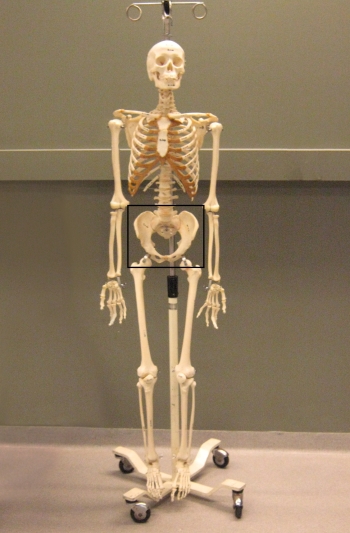
There are several specific physical characteristics in the pelvis that are different between the sexes:

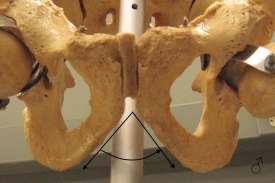
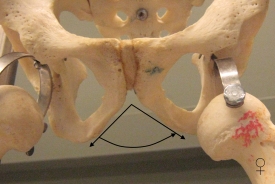
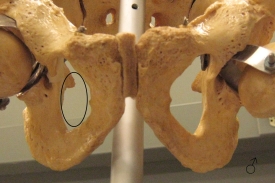
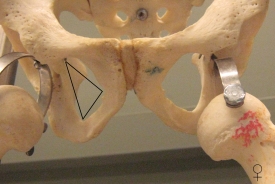
  • Subpubic angle – The angle formed by the joining of the two halves of the pubis at the front of the pelvis. The angle is narrow in males and wider in females; this is partly due to the shorter pubis in males and elongated pubis in females.
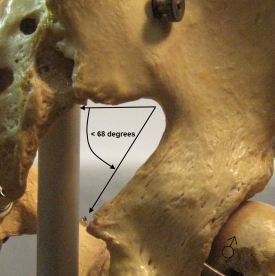
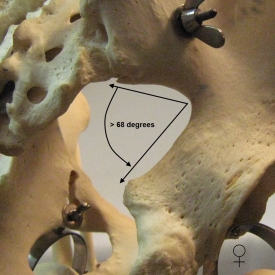
  • Greater sciatic notch – The notch in the back of the hipbone that allows muscles and nerves to pass through the bony pelvic region. The notch tends to be narrow in males (less than 68o) and wider in females (more than 68o).
  • Orbaturator foramen – The hole made by the joining of the ischium and pubis bones in the pelvis that allows nerves and muscles to pass through. It tends to be more oval in shape in males and more triangular in females.
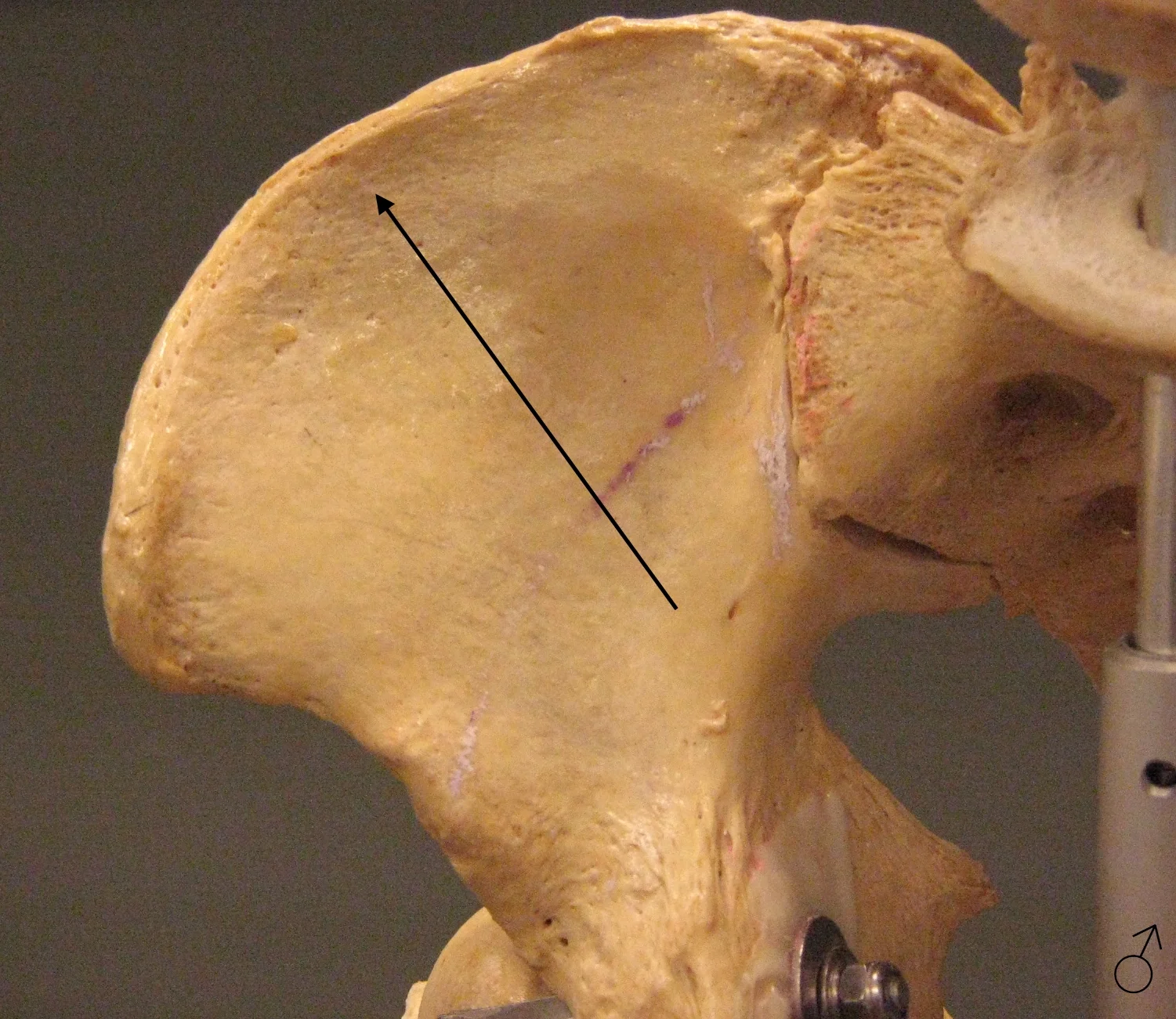
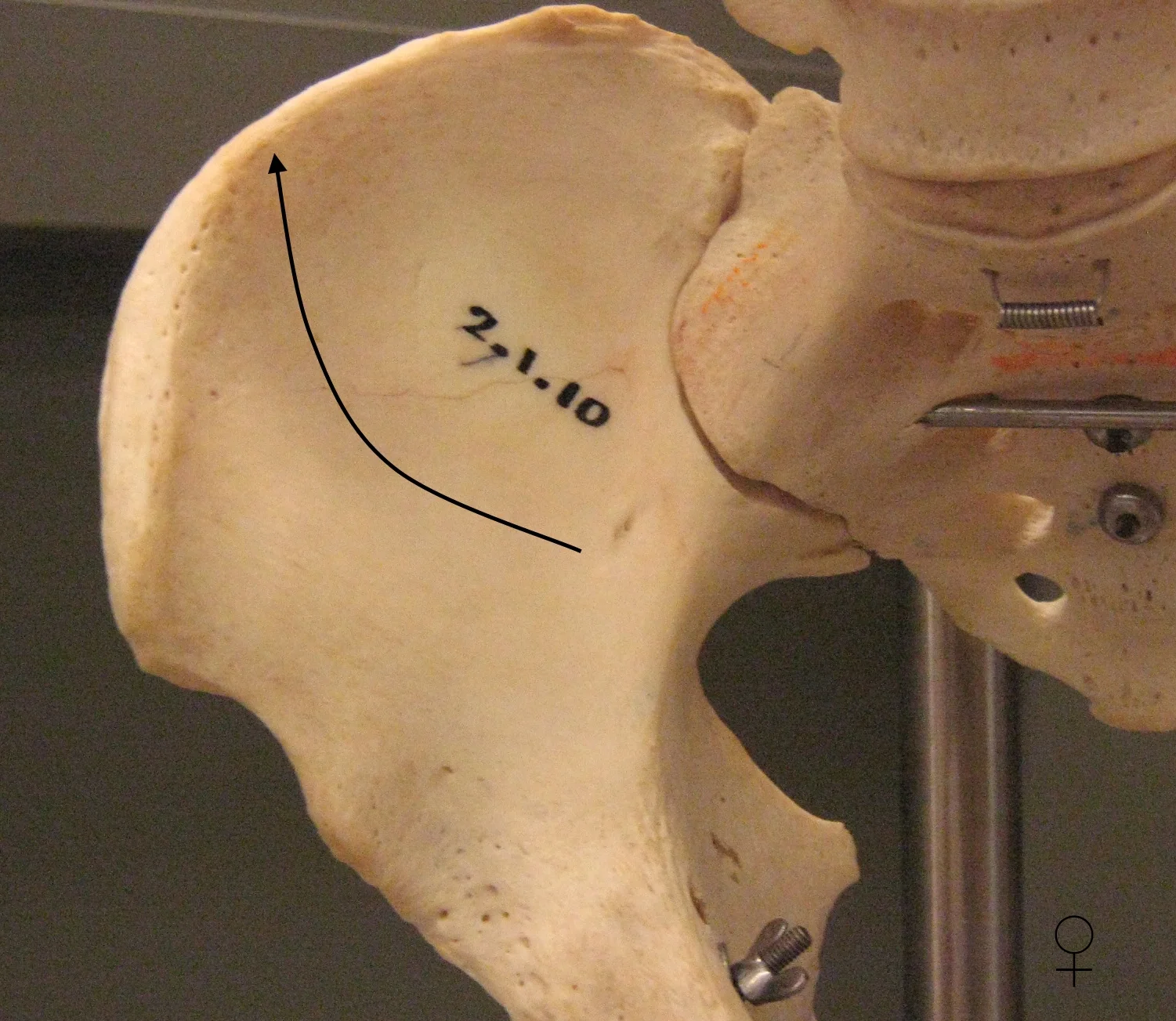
  • Blade of ilium – The ilium is the largest of the three bones in the pelvis; commonly referred to as the ‘hipbone’. It is more flat and vertical in males and more flared or cupped in females.

Because of variation between people, some of these sex differences might be more or less pronounced, so the use of multiple markers is crucial. Better yet is using multiple skeletal elements (if they are available) to confirm the estimate. In our next Forensics 101 post, we’ll look at how to determine sex of a victim based on the skull.

Thanks to the McMaster University Department of Anatomy for providing skeletal specimens.

How Storytelling Can Drive Cops and Scientists Crazy

2192192956_2396facab1_o.jpg

There’s a rule in my household ― when I watch TV crime shows with my family, I’m not allowed to comment on the episode. This comes from years of watching shows with me and listening to me gripe about all the things that are wrong with the episode. There’s usually a lot they do wrong.

Sometimes I think it would be more fun to watch TV if I didn’t know as much as I do. But I have a significant knowledge of forensics from years of detailed study, and a growing knowledge of homicide and general police protocols, and there’s no going back now.

Last year, while attending Bloody Words 2010 in Toronto, it was comforting to sit in on one of the forensics talks (given by a member of the Toronto Police Services) and to hear many of my own views reflected back to me. Apparently, flashy TV storytelling doesn’t just irritate scientists; it really irritates law enforcement as well.

But this kind of flashy storytelling isn’t just seen in TV screenplays. It can also be found in crime fiction. And nothing jerks me out of a story faster than inaccurate details.

So what kind of issues really drive the scientist in me crazy?

  • Science that is conducted at the speed of light ― when DNA or mass spec results only take minutes. At best these protocols take hours; I know, I’ve done them myself. In reality, if a state lab is involved, it can take months or years to get results back.

  • Test results that are rarely ambiguous and usually point directly as a single suspect. Let me assure you, as much as we’d love it to be black and white, science often isn't.

  • Every case is solved successfully. I realize that TV screenwriters need to have 22 cases per year and they can’t leave the majority of them unsolved if they want to satisfy their audience. But leaving the odd case unresolved is realistic and would open the door to some great character-based storytelling.

  • Police officers who blithely cut legal corners or disregard Miranda rights because the plot requires that they do so. In many cases, a little more time spent working out the plot would provide a legal way to achieve the same goals.

  • Scientists with unrealistic skills. In reality, scientists that are experts in their field are very specialized in their specific niche. In other words, they don’t do DNA and fingerprinting and ballistics with equal proficiency. In reality, different areas of the lab perform specific tests. For very specialized testing, evidence is often sent off-site, perhaps even out of state.

  • Unrealistic science. Shining a black light on untreated blood will not make it fluoresce, no matter how convenient that might be.

  • Unrealistic databases. AFIS is a great example of this. The FBI runs a system called IAFIS, but it is in no way as useful as the TV version of AFIS. With only 66 million civilian prints in the system, the chances of finding a match (especially to a partial) is much lower than you would think considering how successful TV detectives are. Realistically, this system takes four to five hours to process a single request, and then police departments will not accept those results as a positive match until a human expert has compared the prints.

  • Expert witness who conveniently have connections/previous ties to the department, thereby undermining their credibility at a crucial moment in a trial. In reality, witnesses are screened with excruciating care, ensuring that this rarely happens.

My point in this list is that a lot of this could have been avoided if a little more time was spent plotting. Yes, in a forty-two-minute TV show, they can’t write in a two month wait for DNA results, but sometimes they swing so far the other way that it’s laughable. Use realism if you can and let your characters react to it. The trick to writing realism is to find a way to hook your reader and them keep them drawn into the story through characterization, no matter how long the lab results take.

I can’t be the only one with a list of pet peeves when it comes to storytelling. What drives you crazy?

Photo by striatic